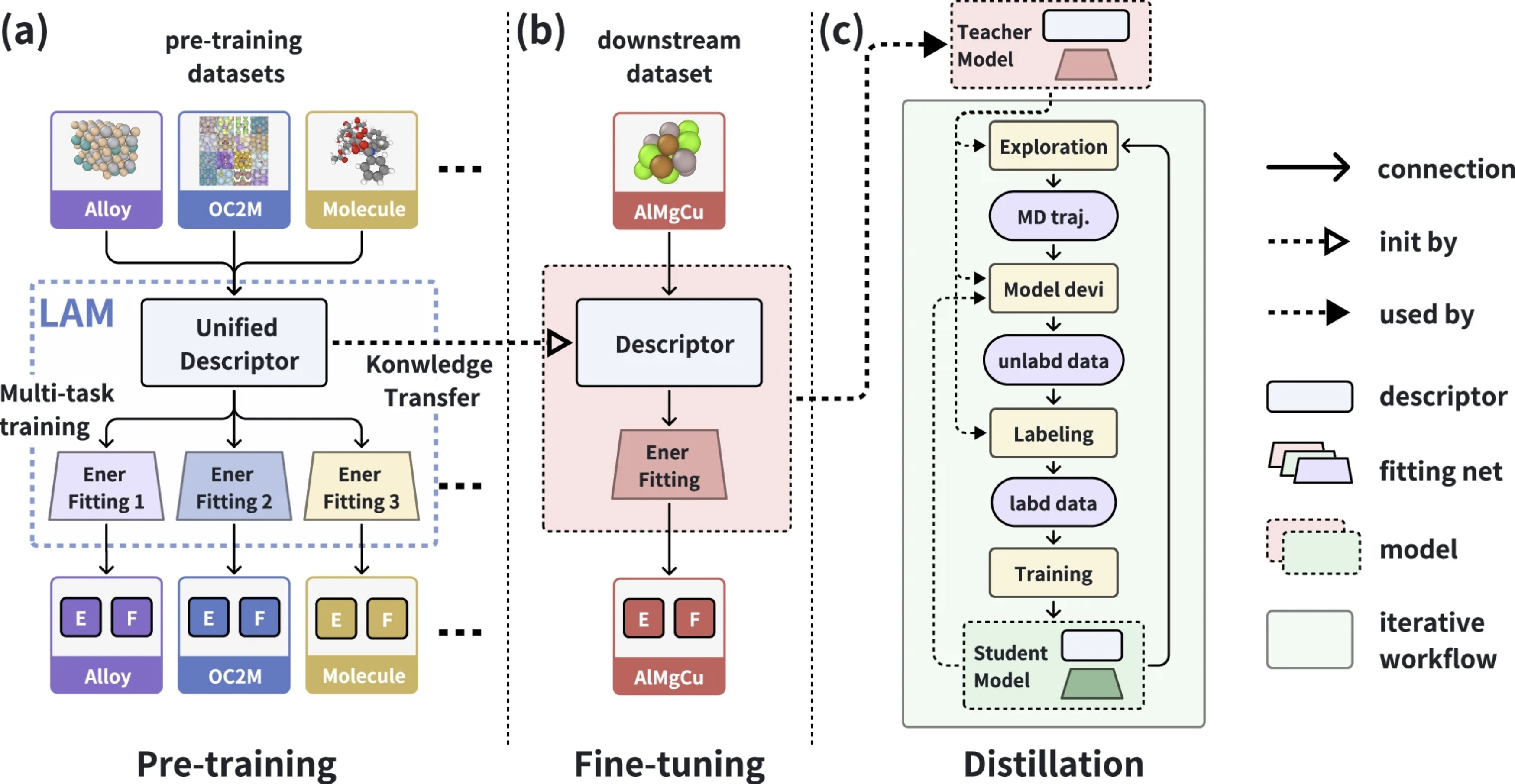
<p>The rapid advancements in artificial intelligence (AI) are catalyzing transformative changes in atomic modeling, simulation, and design. AI-driven potential energy models have demonstrated the capability to conduct large-scale, long-duration simulations with the accuracy of ab initio electronic structure methods. However, the model generation process remains a bottleneck for large-scale applications. We propose a shift towards a model-centric ecosystem, wherein a large atomic model (LAM), pre-trained across multiple disciplines, can be efficiently fine-tuned and distilled for various downstream tasks, thereby establishing a new framework for molecular modeling. In this study, we introduce the DPA-2 architecture as a prototype for LAMs. Pre-trained on a diverse array of chemical and materials systems using a multi-task approach, DPA-2 demonstrates superior generalization capabilities across multiple downstream tasks compared to the traditional single-task pre-training and fine-tuning methodologies. Our approach sets the stage for the development and broad application of LAMs in molecular and materials simulation research.</p>