B.S. in Chemistry — Université de Toulouse (2019) M.S. in Physical Chemistry — Sorbonne Université (2021) Ph.D. in Chemistry — Université Paris Cité / CNRS (2024)
Email: julie.puyo[at]rutgers.edu Office: CIPR-308
About Me:
During my PhD, I applied an implicit electronic-polarization approach (ECC) to improve ion–nucleic-acid interactions. I also used an adaptive string method to characterize RNA cleavage.
My current work applies QM/MM and alchemical free-energy methods to study ion-mediated binding and alkyl-transfer mechanisms in ribozymes.
Full Publications:
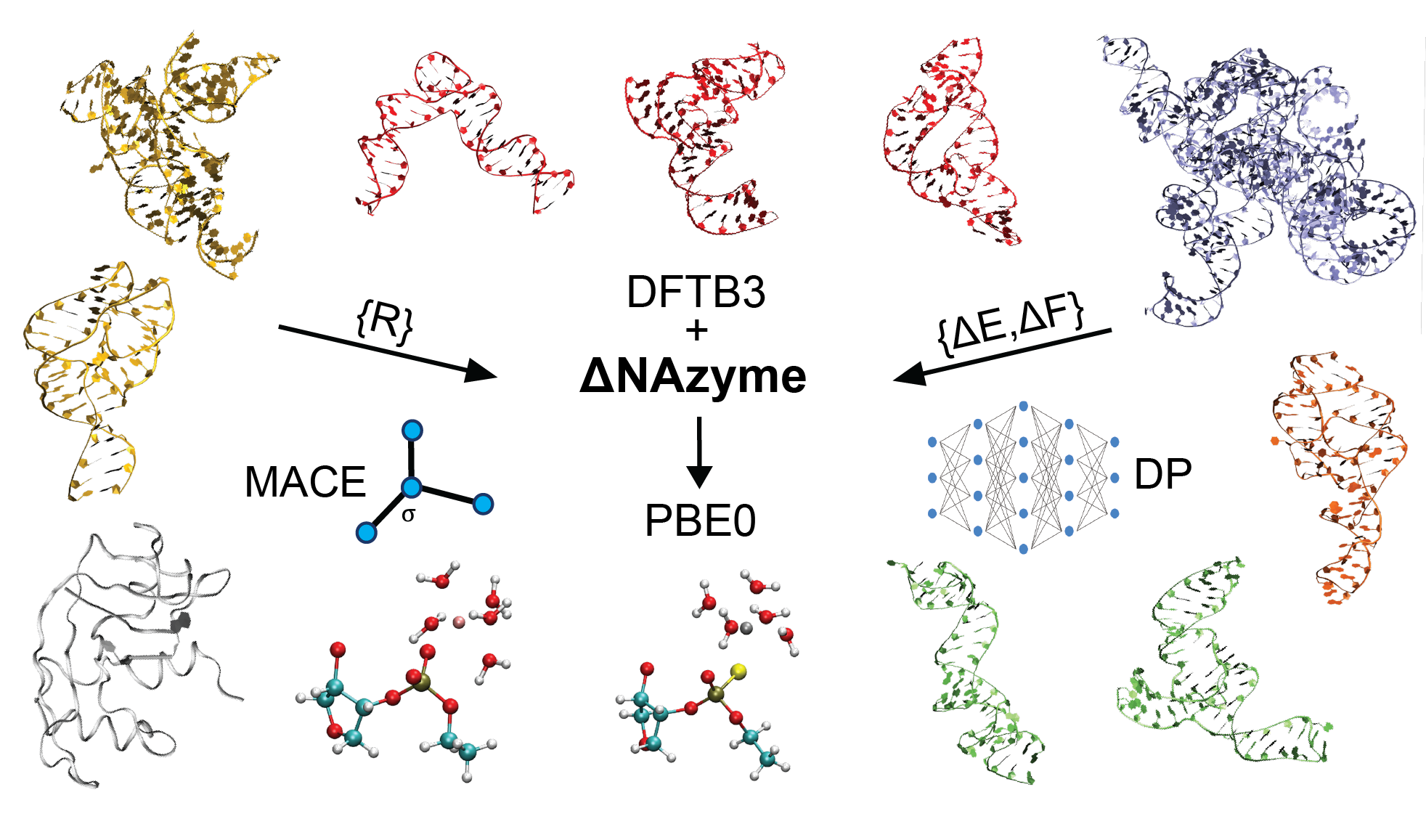
ΔNAzyme:A Foundational QM/MM Δ-MachineLearning Potential for Nucleic Acid Enzyme Catalysis
(2026) DOI:10.1021/acs.jctc.6c01635
Nucleic acid enzymes (NAzymes), including ribozymes, DNAzymes, and XNAzymes, are programmable biocatalysts that catalyze diverse chemical reactions and provide unique platforms for investigating catalysis and engineering molecular function. Their central roles in biology and evolution, together with emerging applications in biotechnology, synthetic biology, and medicine, have created an urgent need for predictive computational design frameworks. Although multiscale computational enzymology integrating ab initio quantum mechanics can, in principle, provide predictive insight into these systems, current approaches remain computationally prohibitive for large, complex NAzymes and high-throughput design workflows. Machine learning potentials have the potential to enhance the accuracy and efficiency of multiscale modeling approaches, but QM/MM contexts in which the MM environment is highly polarizing remain challenging. Nucleic acid enzymes present a particularly demanding case: experimentally relevant predictions require an accuracy that semiempirical QM/MM methods alone cannot reliably deliver in their often large, highly charged, metal-dependent active sites. Building on the range-corrected QM/MM Δ-machine learning potential (ΔMLP) framework, we develop ΔNAzyme, a foundational ΔMLP for nucleic acid enzyme reactions. We generate a training set of QM/MM simulations spanning diverse nucleic acid enzyme classes, with energies and forces computed at both the reference (DFTB3) and target (PBE0/6–31G*) levels of theory, yielding a correction on top of DFTB3 that recovers PBE0 quality results. We train models using both the Deep Potential and MACE architectures. The MACE model exhibits enhanced transferability, which we attribute to the equivariant, many-body message-passing framework. Free energy profiles from case-study reactions validate ΔNAzyme against target-level results and show that the model supports efficient fine-tuning to new nucleic acid enzyme systems with minimal additional data.
Origins of Reactivity in SAM-Utilizing Ribozyme SAMURI-Catalyzed RNA Alkylation
(2026) 148, 31316-31330 DOI:10.1021/jacs.6c08579
Unlocking the design principles of programmable RNA catalysts capable of site-specific chemical modification is critical for expanding the functional and therapeutic potential of RNA. The SAM analogue-utilizing ribozyme (SAMURI) enables site-specific RNA alkylation using either S-adenosylmethionine (SAM) or the synthetic cofactor propargylic Se-2,6-diaminopurinribosyl-selenomethionineamide (ProSeDMA), yet the molecular determinants of its reactivity remain incompletely understood. Here, we combined molecular dynamics, 3D-RISM solvation analysis, alchemical free energy calculations, quantum pKa shift predictions, and ab initio QM/MM free energy simulations to characterize the conformational and electronic factors that govern catalysis. Simulations show that, although the global fold of SAMURI remains stable in solution, the formation of catalytically competent near-attack configurations is rare, indicating that the observed rate depends on access to a minor fraction of these reactive conformations (freact). A putative Mg2+ binding site between the SAM carboxylate and the G30 phosphate, together with a hydrogen bond between the cofactor α-amine and U8:O2, enriches freact. QM/MM simulations support an SN2-like alkyl transfer mechanism and show that ProSeDMA reacts more readily than SAM primarily due to its more favorable electronic leaving group properties that enhance the intrinsic rate (kint). Atomic substitutions at A52 that tune the N3 pKa enhance nucleophilicity, further lower the activation barrier, and increase kint. Together, these results show that SAMURI catalysis is governed by a combination of conformational preorganization and electronic effects, providing a framework to guide the design of new programmable RNA alkyltransferases.


 Position: Postdoctoral Associate